Does not Wisdom Call?
Scripture, music, tradition, and technology

In the process of developing this musical response to the opening paragraphs of the recent encyclical Magnifica Humanitas, something remarkable appeared.
The Pope appeals to Proverbs 8, “invoking the help of the Spirit of wisdom, who has dwelt in the world since its beginning (cf. Prov 8:22-31)” (para. 3).
To begin at the beginning, my favorite verses of Scripture today are in Proverbs 8.
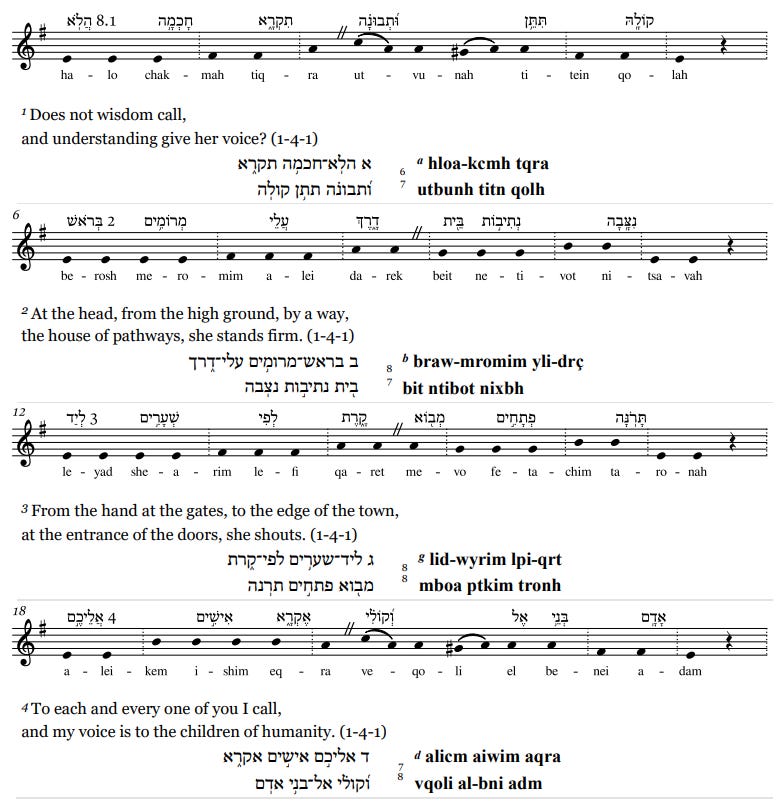
Observe the song at the opening of the chapter: tonic, step up to the supertonic, move to the subdominant, pause. The movement is invitational, pending a response. The request is announced with parallel words in the phrase following the pause, ornamented and returning through the supertonic to the tonic final. The shape of verse 1 is symmetrical. In the language of the notes: e f# A, A f# e.
The movement follows the accents below the text in the Hebrew text itself — silluq, mercha, atnah, (pause, breathe) — then continue to mercha, silluq. The ornament marked above the text in the second half of verse 1 is ole-veyored. In the poetry books, it often signals the return to the tonic and the completion of a thought. In this role, it resembles what later plainsong traditions called the tuba.
Verses 2 and 3 begin with the same ascending shape as verse 1: e, f#, A. They then descend to the mediant, g, rise to the dominant, B, and close again on the tonic. The cadence from B to e is characteristic of the poetry books.
Verse 4 begins differently, with a direct call from e to B, the first natural overtone of the shophar. It is a summons. The music itself matches the proclamatory force of the words. The verse then concludes as verse 1 concluded, with the ornamented return from A through f# to e.
There is a careful density of thought in the opening paragraphs of the encyclical. A similarly careful exegesis is accomplished by the music of the Hebrew Scriptures themselves.
Christians are generally unaware that the Old Testament was transmitted not only as text but as music. Scripture is more than abstract truth and layered thought, though it contains both. It is meant to be sung. Then we learn to hear together, and we are formed into the people that Wisdom calls us to become.
The sections of this poem referenced by the Pope in his encyclical are equally lovely.
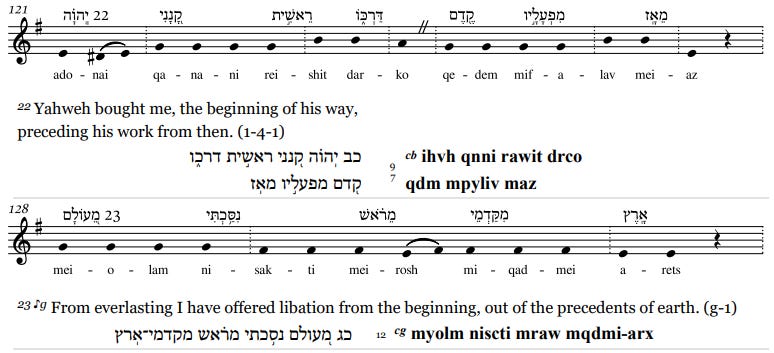
Verse 22 is the creation motif, the opening triad coming to the rest note from above. The books of Job and Proverbs use this motif more than other books.
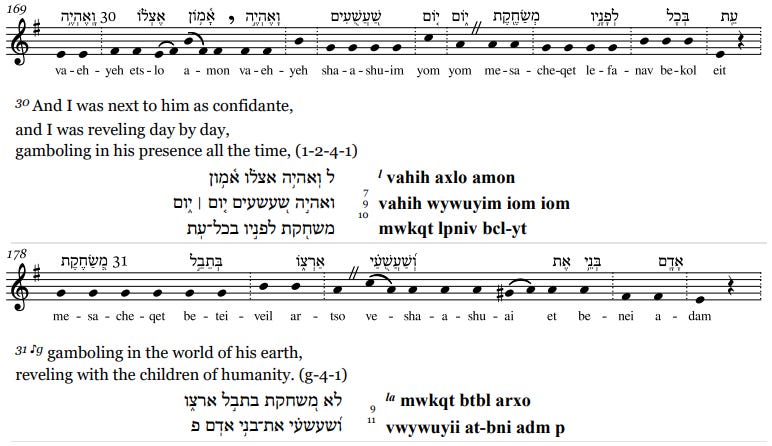
In verse 23, the melody continues verse 22 by beginning on the mediant rather than the expected tonic. The simple movement g, f#, e could be heard almost as a mantra for knowing the cost and tenderness of Wisdom’s delight in her children. It is a pouring out of love from the beginning.
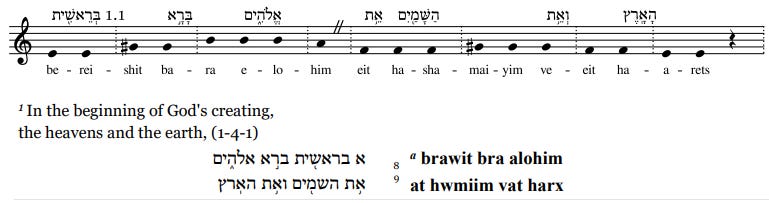
The Hebrew Scriptures include music from the first word to the last: from the opening verse of Genesis:
to the final proclamation of King Cyrus in Chronicles.
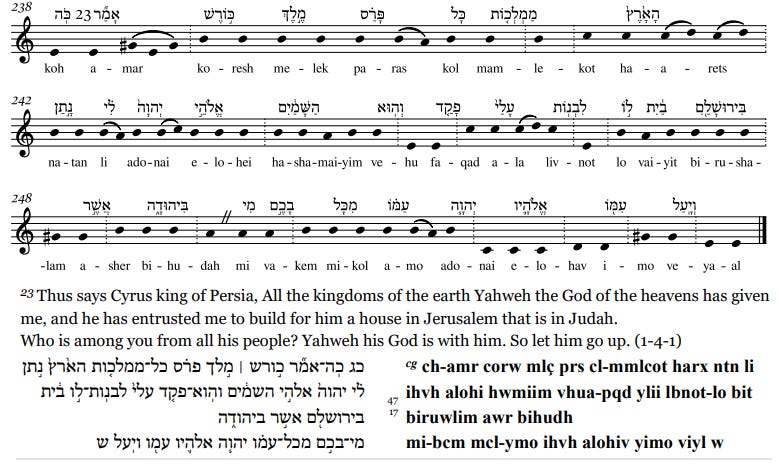
Christian Bibles usually conclude the Old Testament with Malachi, the last of the 12 Prophets. The Hebrew canon, however, concludes with Chronicles, returning to the rebuilding of Jerusalem and the restoration of communal life — themes also echoed in the encyclical.
Reading Scripture without music is mentioned in the Talmud:
“Whoever reads Scripture without melody and studies Mishnah without song, concerning this, Scripture says: ‘I also gave them statutes that were not good.’” — R. Yohanan, in b. Megillah 32a
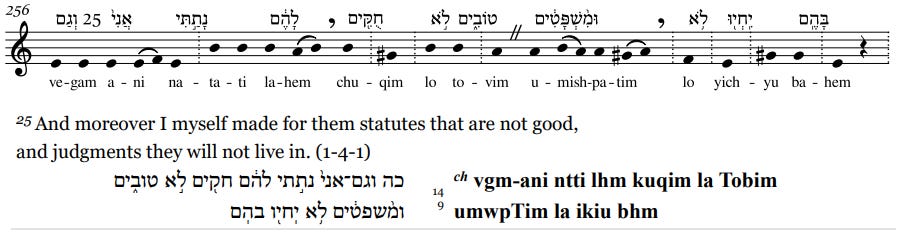
We may ask why we exchanged the embodied hearing of Scripture for abstraction alone. Music is difficult to learn well and is often given low priority. Without melody and motif — without the tone of voice of instruction — we cannot easily inhabit the text or be formed by it. The musical structures of the Hebrew Bible shape memory, expectation, tension, and resolution.
The positive command is to hear.
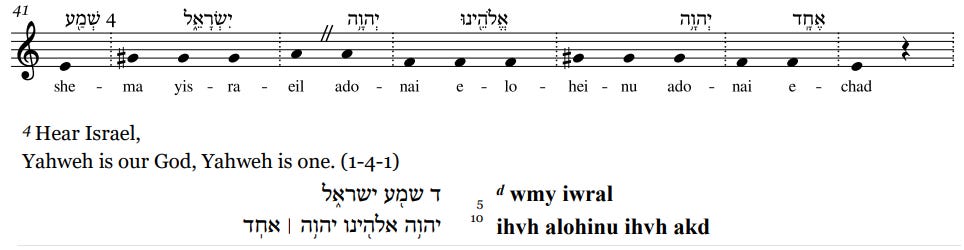
The command is expressed through a supportive motif: the lift from the tonic to the mediant, e to g#, the leading tone creating anticipation before the note of rest and pause. After the pause, the drop of a major third to the f and rise of an augmented second to the g# create tension between home and mid-verse rest, mirroring the tension we have between desire and action within human life itself.
Hearing the embedded music gives movement and cadence to the verses, structure to the passages, and aural allusion to things already learned. Hearing is both the call of Wisdom and the assistance of the Spirit.
Then we may cite with the encyclical (para 17) Psalm 85:10 (11).
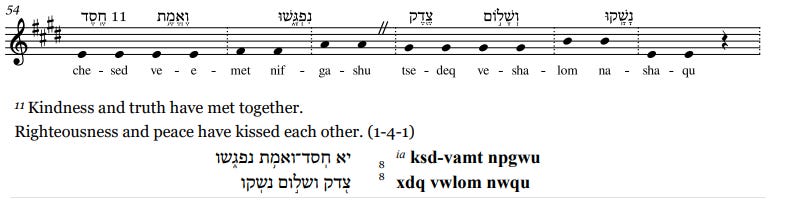
Do you remember this melodic motif? It is the same as verses 2 and 3 of Proverbs 8. See above where we started.
There is something to learn here, don’t you think?
It is not just the music of the Bible that is revealed; it is the Bible revealed through its music.
This is the global generation that can learn it — for the first time.
May the appeal of Magnifica Humanitas and the reality of the music invite all of us not only to interpret the Scriptures well but also to hear and remember.
References
His Holiness Pope Leo XIV, Magnifica Humanitas.
Suzanne Haïk-Vantoura The Music of the Bible Revealed.
MacDonald, D. Robert (Bob) The Song in the Night (Energion 2016).
— The Music of the Bible, The Book of Job (Qualum 2026).
— The Music of the Bible, Psalms (Qualum 2026).
All images in this article are from the 18 volumes of the Music of the Bible. This work is over 6,600 pages in length, 34,000 lines of music for the 23,000+ verses. The entire work of the last 20 years was done with traditional programming.
The tools in use include:
Oracle Database technology.
MusicXML generated from the Hebrew Bible Unicode text.
ePub management from Calibre software.
Translation, formatting, cascading style sheets, and PL/SQL programming were done by the author as described in his notes at https:meafar.blogspot.com.
Scores for every chapter of the Hebrew Bible are available online with the concordance for the translation: https://stenagmois-byte.github.io/SimHebrew-Concordance/musicscores/index.html.
Some performances are available at shirhashirim.org.