
Let’s begin with an example.
Psalm 136 illustrates the short poetic phrases that characterize much biblical poetry. It was almost certainly intended for responsive singing, making it an ideal place to begin.
This verse is the epitome of simplicity in the music of the poetry. The example is shown here in the major mode, following Suzanne Haïk-Vantoura's presentation.
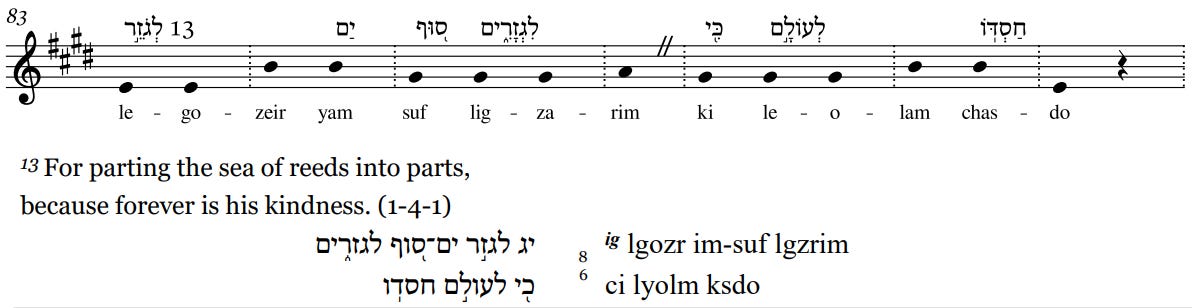
The syllable counts, 8 and 6, show the typical shortness of phrases in the psalms. Psalm 136 represents the extreme of regularity. Every verse ends with the same cadence. Have a look at the full set of abbreviated contours. You will see the x26 on the right hand contours. Click it then Click the search button to see the different books that use this phrase.
The final cadence in every verse of this Psalm is dominant to tonic. This full close1 that we hear frequently is not used in the 21 prose books, but is frequently used in the 3 poetry books.
The sole verse phrase that does not recur in the psalm is the first part of verse 24. We have noted this stark crimson f# recitation note before. The note is frequent in most psalms, but unique in this one.
Notice the repetition of the word גזר gzr, a root that occurs three times in the Psalms, twice in this one phrase using the literary technique we have already observed in the prose — the recurrence of letter sounds g-z-r at the beginning and end of the first phrase. The same root appears in psalm 88 where it defines itself as signifying death.
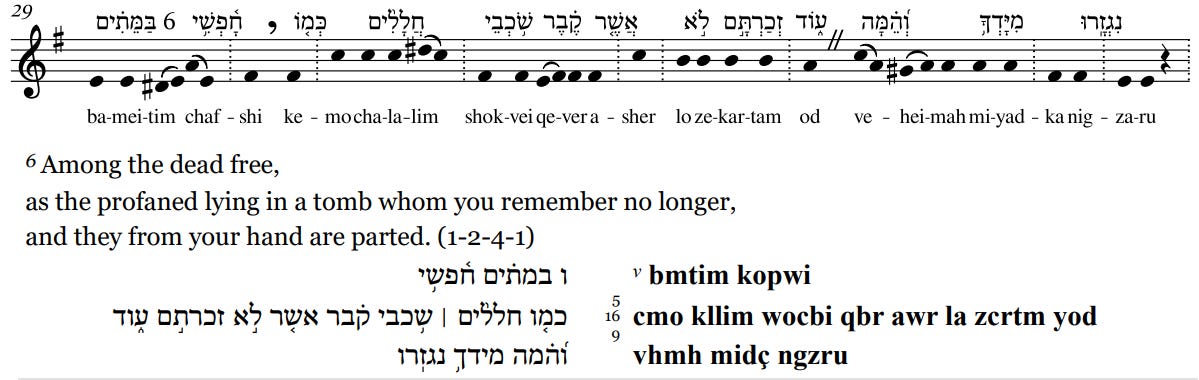
Yes — these two contrasting verses are both ‘poetry’.2
Psalm 88 represents more complex verses. Its phrases vary in length. The first phrase of the tricolon carries the pending thought over five syllables. The high C carries the anguish of dissolution, then back to the f# and pending placement in the tomb. The return to the C for one final note of anguish, then to the announcement of the cessation of memory, the word ‘no longer’ releases the tension to the subdominant rest point. Finally resigned and on the note of repose, the psalmist recognizes they are, from the divine hand, parted. In the last phrase we reach the tonic by step.3
As is clear from the visual map, Psalm 88 is more irregular in its line lengths and shapes. Psalm 88:6 is a tricolon. Only in the poetry do we find this additional cadence on the second degree of the scale. If it is in the verse, it is either on its own as the main cadence, or it precedes the cadence on the subdominant. This verse also illustrates an accent pair, revia-mugrash, used only in poetry, that acts as an announcement of the return to the tonic, hence I have called it the tuba, recalling a similar function in medieval plainsong.
For one example of prose, here is Joshua 9:24, a long verse with 19 accents above the text.
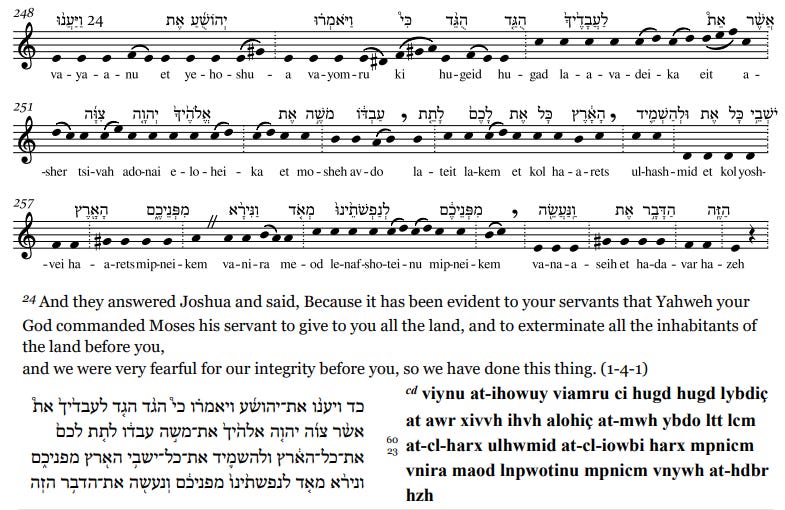
As with the poetry, the recitation approaches the atnah, most of the time from an initial tonic, but not always. Amd from the atnah, it returns to the tonic. There are no codences on the supertonic in the prose books. The atnah can be early in the verse and it can be very far into the verse as it is here in bar 259. This is a highly emotional verse as instanced by the several recitations on the high C and only four syllables on the B of 83 in the verse. It is easy to see that the phrases are long and that breaths are required.
This unique verse has 19 ornaments above the text and 10 reciting notes below the text. The ornaments are on the tonic, e qadma, azla, revia, telisha-qetanah, qadma, on the C pashta, pashta, telisha-qetanah, qadma, azla, continuing on the C pashta, pashta, then on the B zaqef-qatan, breathe, back to the C pashta, zaqef-qatan, breathe, then d f g# A pause // qadma, C pashta, pashta, zaqef-qatan, breathe, then e g# f e. The Hebrew in the lower left of each image shows the cantillation diacritics only.
There are snippets of poems in the prose books, but they do not use the te’amim of the poetry books. In a subsequent article I hope to look at some of these.
The prose books and the poetic books form two closely related musical systems. Many of the signs are shared. When one begins to examine all the music, the patterns and distinctions become clearer. Hearing those patterns is the beginning of understanding the musical ‘grammar’ of the Hebrew Bible.
The images are taken from The Music of the Bible, The Psalms. A full introduction to the deciphering key is in the initially published volume, The Music of the Bible, The Book of Job. These volumes are published by Qualum Publishing. The image from Joshua is queued for production in due course.
There are playback videos for Psalm 88:6 and Psalm 136:8 here. Mechanical playback is limited in expression.
‘Full close’ is an anachronism of course, but so familiar to us. In notation, this is B to e, sol-doh, from the fifth degree of the scale to the first, mathematically the relationship of the fifth to the tonic is 3:2. The relationship to the tonic pitch contains tension and wants to return to its home. The recitation on the dominant also attracts attention and is used frequently as the opening interval, doh-sol, of a verse in all 24 books, prose and poetry. In accent sequences, this is silluq to munach, e to B, and the closing interval, munach to silluq, B to e. Discussing this music I find myself moving constantly among four or five languages: modern musical terminology, scale degrees, Hebrew accent names, and written notation and even occasionally moveable doh solfege. Using solfege is appropriate because each note in solfege has its corresponding hand-signal as do the te’amim. Hand signals are outside my usual frames of reference. You can see why it is difficult to talk about music — there are many languages, each one competing for attention.